Field Notes: Project Update — December 2025 - Study Strategy & Performance in Rural and Remote Nonprofits
Ethics approval for this research was granted by Athabasca University on October 21, 2025, and a Research Agreement with the Council of the Haida Nation was formally approved on December 12, 2025.
Interviews and analysis are now underway, with participation from non-profit organizations across Haida Gwaii. I am deeply grateful to everyone who has taken the time to share their experiences, insights, and reflections. Your contributions are helping shape a grounded understanding of strategy and performance in rural, remote, and Indigenous-serving organizations.
Gaajiiaawa Linda Tollas and Jaad Gudgihljiwah Dr. Michaela McGuire will support analysis and interpretation in the months ahead, ensuring the findings remain connected to both Haida and academic perspectives.
Interviews and analysis will continue into February 2026, with the research scheduled to conclude in March 2026. A reflection on key learnings will follow.
Haawa - haw’aa — thank you to all who continue to support and guide this work. As this work continues into 2026, I carry the strength and kindness of my mother and mother-in-law, whose guidance and strength this year continues to shape how I see the world and care for others, at home and within our community.
I began volunteering at a young age, and most of my work has been within non-profits. From helping with community events through the Daajing Giids Community Club where I mostly ran social media, built a website, and wrote grants in my twenties to spending nearly seven years as a Tourism Counsellor with the Friends of the Visitor Centre to pay my way through school, my experience has moved through almost every corner of the small-town nonprofit world — from staff to governance to Rec Coordinator/Executive Director.
And how my lens has shifted.
As we learn in business courses, nonprofits need strategy too. They need to track metrics like social value, ensure financial stability, and think long-term. And not just about the next fundraiser, but about how to remain relevant, resilient, and rooted in their communities. I’ve also learned to see my own growth areas along the way. I don’t have decades of board experience, but I know when a board is functioning as governance versus when it’s operating day-to-day. I have the perspective now to look out and see how empowering staff to create value can make all the difference when volunteer time runs thin.
From the Online Classroom to the Coast

When I began my MBA with Athabasca University, a course taught by my eventual supervisor for my final applied project, Dr. Conor Vibert, sparked something familiar but unspoken. The models and frameworks we studied, like the Balanced Scorecards, Miles & Snow Typology, Strategy Diamonds. These were designed for large, well-resourced systems. But they rarely captured the reality of small-town nonprofits, where strategy lives in conversations, relationships, and community trust. A few years ago, we hired Allison Habkirk to aid in our board’s strategic planning. Another year later, following my coursework in strategy, performance, and operations, we landed on this 5-year plan. Three three-hour evening sessions with our courageous and supportive board led us to adopt a 5-year financial request to the North Coast Regional District, and a new vision statement that better reflected what we all want: recreation for everyone in our community, for a lifetime.
Those sessions reminded me how powerful it is when strategy feels shared, when everyone in the room (or on Zoom) contributes to shaping a direction that feels both practical and hopeful. The members with their own board experience were instrumental in shaping a strong strategy. But translating that kind of organic, community-driven planning into formal business frameworks is not always simple.
Take the Balanced Scorecard, for example. It is a well-established tool for linking strategy to performance, but its design assumes consistent data, defined departments, and time to meet, reflect, and adjust. In small-town nonprofits, those conditions rarely exist. We do not have full-time analysts or multiple managers to review metrics. Most of us are juggling programming, budgets, and maintenance calls between school drop-offs and community events. And while I can do data analysis, my time I feel is more valuable on the frontline.
I have tried to apply pieces of the framework, and it does help clarify goals and communicate impact, but it is also hard to keep up with when you don’t have other full-time staff to delegate to. It’s very common for our local non-profits to have seasonal, part-time staff. And those with full-time positions are not relieved of duties; these individuals must be generalists, from strategy to operations to human resource management.
“Plans are worthless, but planning is everything.”
– Dwight D. Eisenhower
The process of planning and strategy offered its own set of benefits to our organization, that goes without question. However, Haida Gwaii is often cited as the land of plans and no action, and I strive very hard to crush that sentiment. That starts with critiquing the design.
Rethinking the Balanced Scorecard for Rural & Remote Non-Profits
When I first built our Balanced Scorecard, I placed the financial perspective at the top. That is how most business texts present the model. In daily practice on Haida Gwaii, this order does not match how value is created. Our foundation is people, relationships, and learning. Internal processes come next. Community outcomes are the goal. Financials are the result of those three working well, not the driver. So, it should not be at the top. See my mistakes or rather, learning process, below:
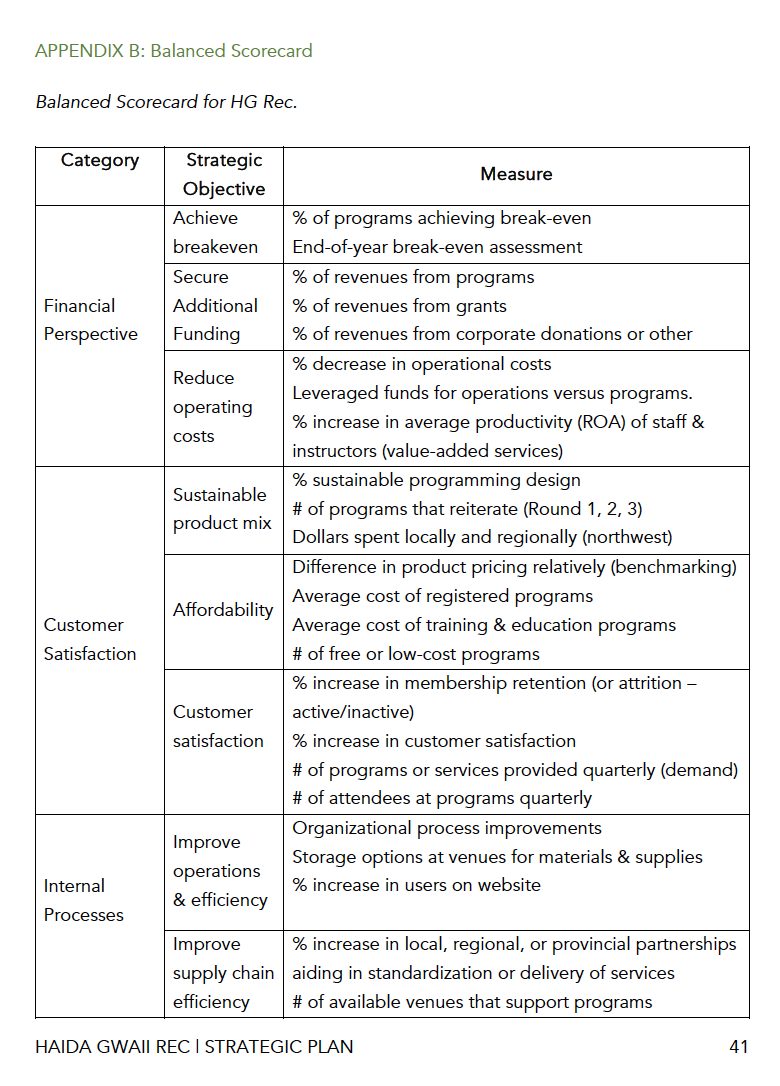

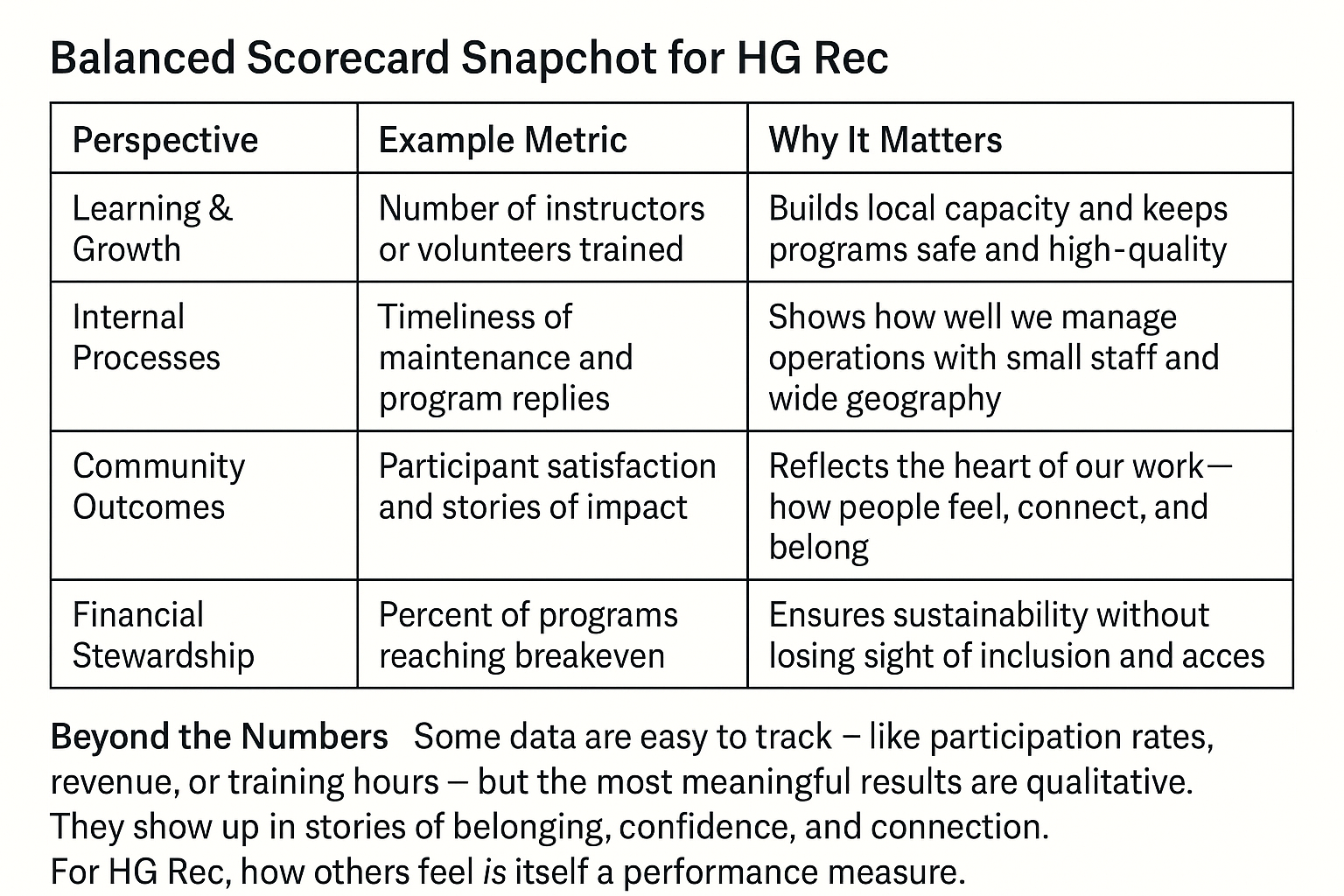
The research I cited in my proposal for my applied project points in the same direction. Rural and remote nonprofits operate under high uncertainty and adapt through partnerships, trust, and community responsiveness rather than through revenue growth alone (Walters et al., 2023, Administrative Sciences: https://doi.org/10.3390/admsci13090197). Sector reports in Canada describe a persistent data and evaluation capacity gap that is most acute outside large centres, which makes financial-first scorecards difficult to maintain and sometimes misleading for advocacy (Imagine Canada report by Bartle-Tubbs and McNamee, 2024: https://imaginecanada.ca/sites/default/files/DARO%20Report%20Nonprofit%20Data.pdf). Indigenous evaluation approaches emphasize respect, reciprocity, relevance, and responsibility, which invites a reordering of priorities and measures (Government of Canada, 2022: https://www.justice.gc.ca/eng/rp-pr/jr/eiaer-eaame/appendixc-annexec.html; Kirkness and Barnhardt, 1991). The PM4NP adaptation of the balanced scorecard argues for stakeholder, internal, and learning perspectives taking precedence over pure financial metrics in nonprofit contexts (Scholey and Schobel, 2016). All of this aligns with what we experience on the ground.
Don’t get me started on how many metrics I would need to have tracked to follow that balanced scorecard! I don’t have the budget to automate this, do it all myself, or even delegate. Instead, I challenged myself to think about HG Rec’s strategy and what’s MOST important, using Learning and Growth as our top perspective, with financial stewardship dead last. Trust me, I love breaking even. But it’s not always the target or totally realistic.
Beyond the Numbers: Storytelling as Strategy
Taking photos has always been something we do well. Whether it is a youth grinning mid-game on the soccer fields, a volunteer coaching in the rain, or swim lessons in our lakes, these moments tell a story that data never could. We need these stories for our funders, for social media, and for the newspaper. They do more than show that we are active; they help others see what community recreation looks like on Haida Gwaii. When you do not have a dedicated recreation facility, sometimes it is the photos that remind people we already do. They show the gym that becomes drop-in sports at night, the hall that transforms into an event space, the art room doubling as a space for a sewing workshop on the weekends. A picture says a thousand words, but here it also builds the case for support. It helps others imagine the recreation centres that already exist in every town, the many private and public buildings that help us move our bodies, gather, and belong. This, too, is part of our performance story. Recreation is not only about infrastructure or metrics. It is about relationships, imagination, and recognizing what we already have, not what we lack.
The balanced scorecard can measure programs, budgets, and participation, if we let it, and if we focus on what truly matters. But what inspired my applied project was realizing that sometimes, attendance, photos, and a sense of how our communities feel are enough. Those simple indicators say more about the health of recreation than any spreadsheet ever could. They show who shows up, who feels welcome, and how a space makes people feel when they leave. That is the kind of evidence that lives in community memory, not just in reports. For me, that is where strategy begins — not with metrics, but with meaning.
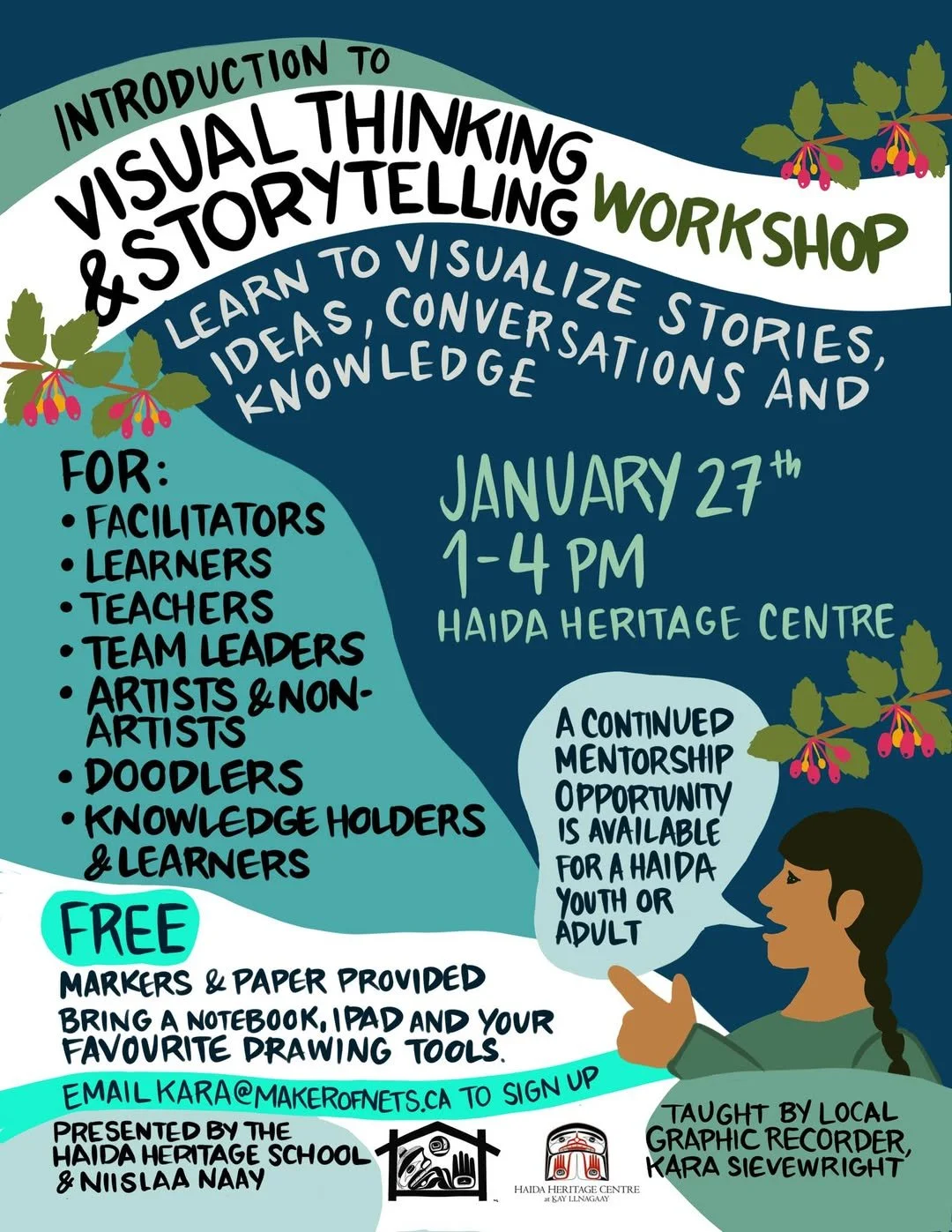
I had the pleasure of attending a visual-thinking and storytelling session led by Kara Sievewright of Netmaker Designs in 2024, and it sparked a fusion of academic thinking with the knowledge-translation piece. Kara is an illustrator, graphic recorder and visual sense-maker who translates ideas, information and stories into meaningful visuals. Her approach reminded me that sometimes it’s not enough to apply tools like the Balanced Scorecard in isolation. We also need to see strategy, feel it and connect to it visually and emotionally, especially in small-town and Indigenous-serving organizations. Check out some of her incredible work locally. I learn not just through institutions, but from the brilliant and creative minds that live here and give back to our communities, daily.
Taking This Work Further
I am not an expert. I make mistakes too. But I know what our organizations need in real time and just as importantly, what work we do not need more of. After years of working in and with small non-profits, I see how much time we spend reacting to funding demands, writing reports, and trying to fit our work into frameworks that were never designed for us. If we keep pushing toward strategy and performance tools without questioning how they apply to small, coastal, and Indigenous organizations, then our voice will never be fully represented in literature or in classrooms.
This project is one small step toward changing that.
It is not a full thesis. It is a required applied research paper for my MBA through Athabasca University. A Phase 1 paper will be submitted in December to meet graduation requirements. After that, I plan to continue this work into 2026 to allow more time for community engagement, approvals, and meaningful outputs that can directly support local organizations.
This phased approach ensures the research is done responsibly and respectfully, and that it reflects Haida Gwaii’s realities. Five months is not enough time to do that well.
If you are part of a local non-profit, I would love to connect.
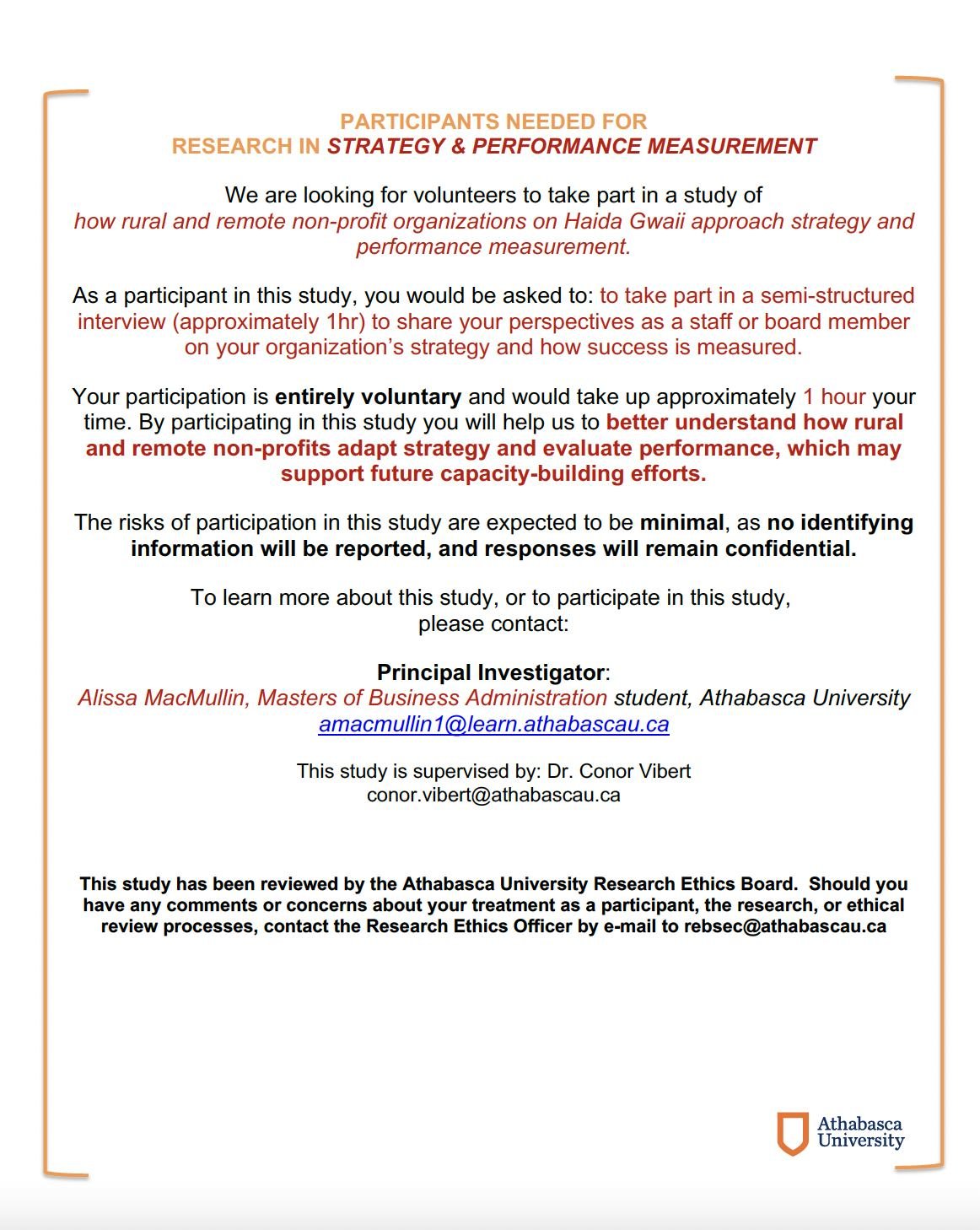
👉 Who can participate
Staff (1) or board members (1) from any Haida Gwaii non-profit organization.
👉 What participation involves
A confidential, one-on-one interview (about 60 minutes) for each member (2 interviews) about your organization’s approach to strategy and evaluation. With permission, the interviews will be audio-recorded to ensure accuracy. No names will be published, only general archetypes such as “social services organization.”
👉 What your organization receives
Each organization will receive a customized performance measurement resource co-designed with your team — for example, a balanced scorecard or a framework rooted in local values. You will also receive a lay summary of findings and, if interested, an optional presentation to staff or board members. Please don’t let me add more work to your already busy schedules, you deserve more than that. This is my way of giving back to those who gave me so much all these years.
👉 Haida-led organizations
I am currently seeking a research agreement with the Council of the Haida Nation following ethics approval by the university. I am sharing early information now to be transparent and to allow time for the appropriate approvals. UPDATE: A research agreement was approved December 12. 2025 and interviews with Haida-led organizations can now proceed.
Participation is voluntary, anonymized, and confidential and follows First Nations OCAP principles® for security and ownership of data.
If you have questions or would like to take part, please contact me at amacmullin1@learn.athabascau.ca.
Participants will receive a Letter of Information and Consent Form outlining all details, including potential risks, benefits, and confidentiality protections. Haawa - haw’aa - thank you for considering this project.
